
By Dr. Joseph Iacovazzi, Assistant Professor of Wildlife Biology
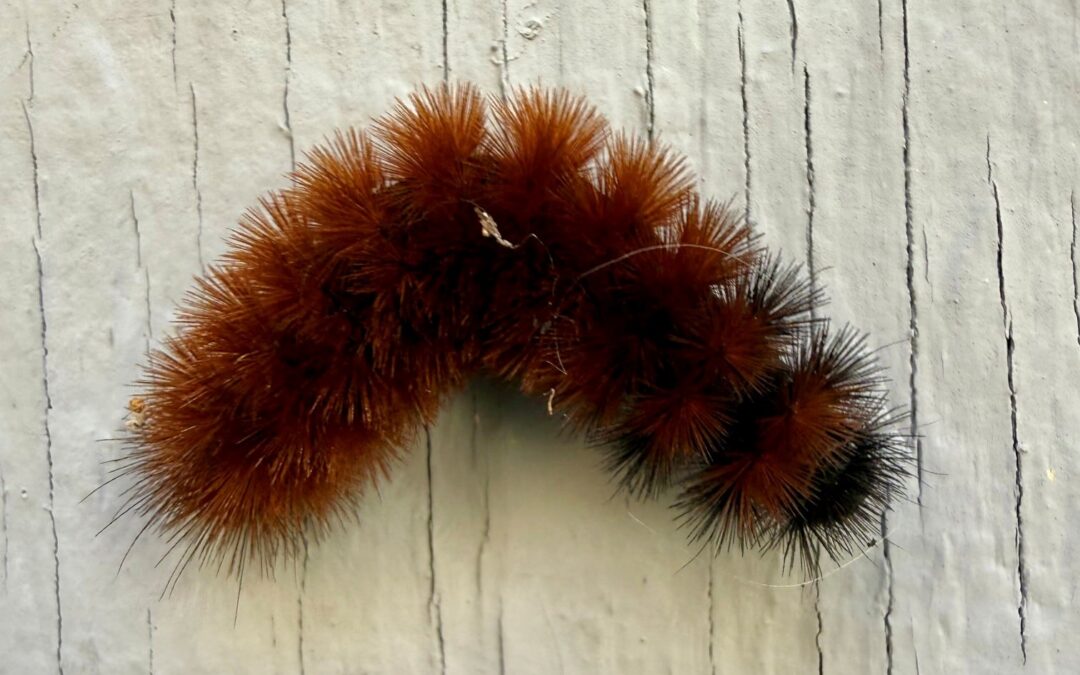
As autumn settles over Keystone College, a small traveler may catch your attention along a sidewalk or near a patch of fallen leaves. Covered in stiff bristles, with black at both ends and a rusty brown band through the middle, the banded woolly bear caterpillar is a familiar sight at this time of year. Its appearance often prompts a question: Can those bands tell us what kind of winter is coming?
The answer is no—but the science behind this caterpillar is just as interesting as the legend.
The banded woolly bear is the immature stage of the Isabella tiger moth, Pyrrharctia isabella. Although its common name suggests a furry mammal, its “wool” consists of bristles called setae. The caterpillar feeds on a variety of low-growing plants. In autumn, its wandering becomes especially noticeable as it searches for shelter where it can spend the winter. A woolly bear crossing a campus path is preparing for the season ahead.
According to a longstanding folk belief, a narrow brown band and larger black sections signal a harsh winter, while a broad brown band promises a milder one. Some versions assign the caterpillar’s body segments to successive weeks of winter, treating its pattern like a miniature seasonal forecast. Others claim that the darker end reveals whether the beginning or end of winter will be most severe.
So what do the bands actually mean? They are part of the caterpillar’s coloration, which varies among individuals and changes during development. Caterpillars grow by molting, or shedding their outer covering. Age, developmental history, and environmental conditions experienced while growing can contribute to differences in appearance.
That does not make the band a precise measuring tool. A wide brown band cannot tell us a caterpillar’s exact age, reconstruct the weather it experienced, or predict snowfall months ahead. The scientifically useful message is that coloration reflects the insect’s biology and development, rather than a forecast of future weather.
The woolly bear’s real winter story unfolds beneath the leaves. Banded woolly bears overwinter as caterpillars, sheltering in leaf litter and other protected places. In spring, they resume activity, form cocoons, and eventually emerge as moths.
Their survival involves more than finding a hiding place. Research on Pyrrharctia isabella shows that these caterpillars can tolerate freezing under suitable conditions. Seasonal physiological changes help protect their tissues, and compounds such as glycerol contribute to protection against freezing injury. Freeze tolerance has limits and depends on conditions; it does not mean the caterpillar is immune to cold.
For the Keystone community, spotting a woolly bear offers a chance to pause and observe the seasonal changes happening at our feet. Take a photograph, notice its bands, and watch where it travels. Comparing several individuals can turn a familiar autumn encounter into an exercise in careful observation.
Its bands may inspire stories about winter, but its biology tells a compelling story of its own: a small insect preparing to survive the cold and continue its transformation in spring.
Photo: John Hickey