Thomas G. Cupillari Astronomical Observatory - Route 81/Exit 202/index.dot
- Home

- About Keystone

- Featured Facilities

- Thomas G. Cupillari Astronomical Observatory - Route 81/Exit 202/index.dot
Summer 2008 Observatory Schedule
The Thomas Cupillari Astronomy Observatory at Keystone College announces the summer series of public lectures and observing sessions. They will be conducted every Monday and Wednesday evening beginning July 7 and continuing through July 30. Each week the Monday lecture will be repeated on Wednesday. The programs will begin at 8:30 PM and are free of charge. They will include an illustrated lecture, and if the sky is clear, participants will observe through the telescope(s).
- The topic for the first week is Mars Update by Tom Cupillari
- The second week is a talk on Meteorite Impacts by Joann Kamichitis.
- The third week's topic is Observing Planets with a Telescope by John Sabia.
- The final week's program will be Galaxies: Types and Interactions by Joann Kamichitis.
Among objects to be observed will be the planets Venus, Jupiter and Saturn; the Moon, and various double stars; star clusters, nebulae, and galaxies.
The July programs will be conducted regardless of sky conditions and will be cancelled only because of a threat of severe weather.
Groups such as school classes, scouts, and community organizations must make an appointment for a night other than a public night. If further info is needed call 945-8402 or email tom.cupillari@keystone.edu.
History
The telescope that is the heart of the Keystone College Observatory has a history stretching back to the late 19th century. It was constructed originally for Beloit College, WI, in 1882 by the firm of Alvan Clark & Sons of Cambridgeport, MA, makers of the finest refracting lenses ever ground in the United States. The instrument was acquired in 1967 by Dave Garroway, a television pioneer of the 1950s best known for hosting the "Today" show on NBC.
Moving to the West Coast from his home near Boston in 1971, Mr. Garroway decided against taking the telescope along and advertised it for sale. Thomas G. Cupillari, Keystone professor of astronomy and physical science, saw the advertisement and wrote a letter of inquiry to Mr. Garroway. A series of communications between the two men followed. Ultimately, Mr. Garroway, assured that Keystone would make the telescope available to students of all ages and to the general public, rejected all other bids and chose Keystone as the new home for his 'baby'.
Gifts to the 1972 Annual Fund, including $5,000 from the Scranton Area Foundation, made possible the installation of the telescope and dome and construction of the adjacent service building. A grant from the National Science Foundation financed the purchase of a spectroscope, Schmidt camera and photometer.
In 1996 the Clark lens was installed in a new equatorial mount with a modern electronic drive system.
Alvan Clark and his sons, Alvan Graham and George, were perfectionists. The two Alvans ground the lenses manually, tested them in a tunnel adjacent to their factory basement, then corrected and polished them with infinite care, using their bare thumbs for the final delicate touches. George, a mechanical expert, made the controls.
Rated on a scale of zero to 10, zero representing perfection, the 9-1/2 inch glass in Keystone's telescope scores about a two. This is far better than lenses from other makers and even better than other Clark lenses.
The best known telescopes made by the family are the 25 inch at the Naval Observatory in Washington, DC, the 36 inch at the Lick Observatory in Santa Cruz, CA, and the 40 inch at the Yerkes Observatory in Williams Bay, WI, the largest refractor ever ground.
Image Gallery
Features
Lens: Diameter, 9-1/2 inches; focal length, 142-1/2 inches
Finder Telescope: Diameter, 3 inches; focal length, 45 inches
Manufacturers: Lens and finder telescope, Alvan Clark & Sons, Cambridgeport, MA, 1882.
Equatorial mount and drive system, D & G Optical, East Petersburg, PA, 1996.
Statistics: The main support pedestal is 9-1/2 feet high and weighs 2,000 pounds. The twelve-foot tube, equatorial head, and counterweights have a total weight of 500 pounds, yet can be moved by a 4-pound pull when properly balanced. The dome, 16 feet in diameter, rotates a full 360 degrees. The automatic tracking mechanism is powered by a small electric motor that is connected to a series of gears, which rotates the telescope.
The telescope will magnify effectively from 70x to 700x. Because of limiting conditions of the atmosphere, however, it is used most often from 100x-300x. It is capable of bringing into view stars that are 1500 times fainter than the faintest stars visible to the naked eye. Planets within easy reach of this instrument are Mercury, Venus, Mars, Jupiter, Saturn, and Uranus.
Other Activities
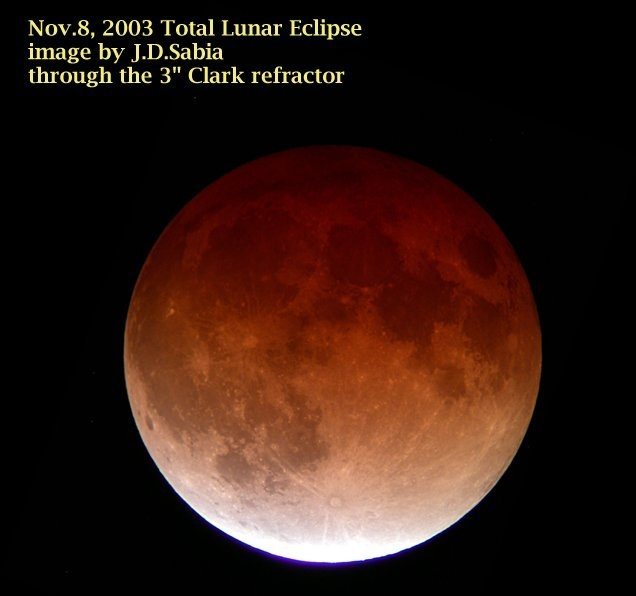
In addition to public programming, the observatory staff, some students, and members of the LAS engage in observational programs which include, but are not limited to, lunar and planetary observations, astrophotography, photometric measurements of variable stars, and sidereal time studies.
Other Instruments
- 5 inch f/5 wide field refractor
- 3.1 inch f/15 refractor
- 10 inch f/6 reflector
- 10 inch f/10 Schmidt Cassegrain
Directions to the Keystone College Observatory
From Interstate 81: Route 81 to Exit 202, Fleetville/Tompkinsville. Take Route 107 West 1.5 miles. Turn left on Hack Road.
From Routes 6 & 11: Take Route 107 East to Fleetville Corners (red blinking light). Continue on Route 107 for approximately 3 miles and turn right on Hack Road.