
Assistant Professor Joseph Iacovazzi Published in Annals of the Entomological Society of America
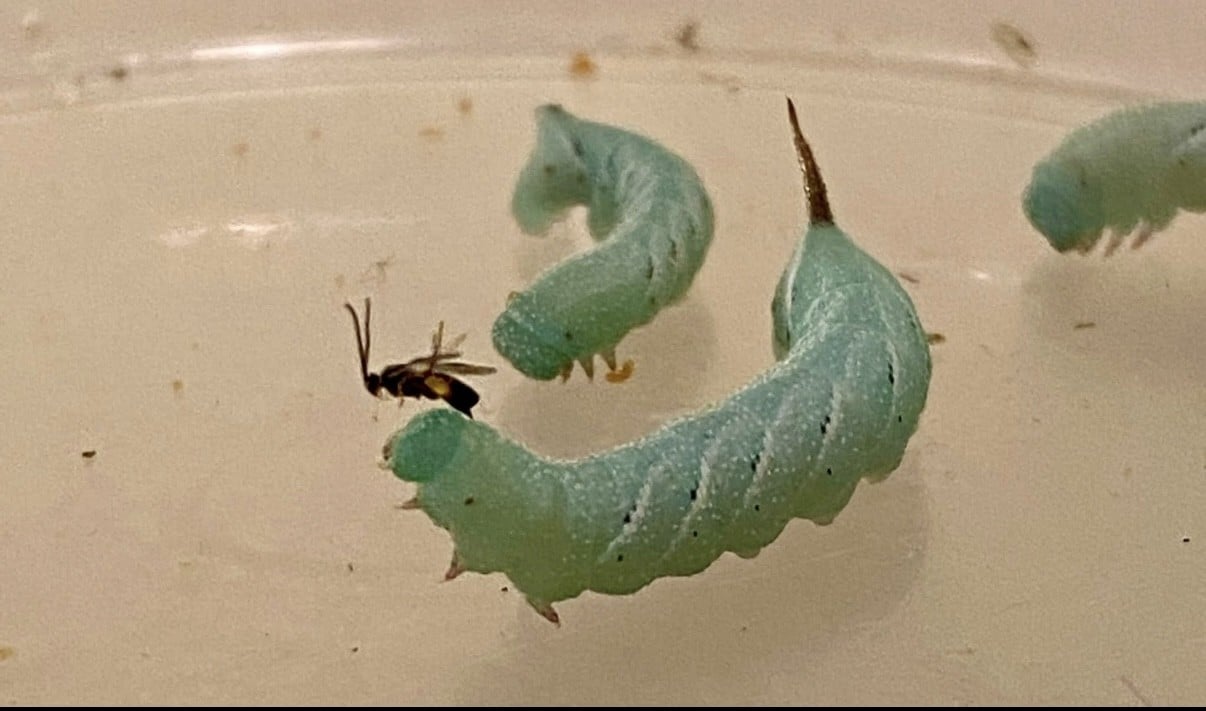
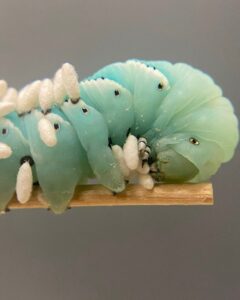 Assistant Professor of Wildlife Biology, Joseph Iacovazzi, Ph.D. recently had his article, “Behavioral Changes in Caterpillars of the Hawkmoth Manduca sexta (Sphingidae) Induced by the Parasitoid Wasp Cotesia congregata (Braconidae),” published in the Annals of the Entomological Society of America. The study, which builds on Dr. Iacovazzi’s graduate research at Binghamton University, delves into how parasitoid wasps manipulate the behavior of their caterpillar hosts. The wasps lay their eggs inside the caterpillars, and as the larvae hatch, they alter the caterpillar’s actions to benefit their survival. This unique parasitic behavior offers fascinating insights into the complex relationships between species and the evolutionary arms race between hosts and parasites.
The research has broader implications for insect ecology, particularly in understanding parasitoid-host interactions and their potential role in pest management. By learning how parasitoid wasps influence caterpillar behavior, scientists could develop more sustainable, natural pest control methods, reducing the reliance on chemical pesticides. Additionally, the study advances our knowledge of behavioral ecology, revealing how parasitism can shape the behavior of hosts in surprising ways, and prompting further exploration of parasitism across species.
Dr. Iacovazzi is proud to share his findings, which reflect his commitment to both research and education. This publication is part of his ongoing effort to engage the next generation of scientists in exploring ecological interactions and to inspire further investigation into the fascinating world of insect behavior and parasitism. His work continues to contribute to a deeper understanding of how organisms interact in nature and how these interactions can be harnessed to address ecological challenges.
This research not only sheds light on the fascinating world of parasitoid-host dynamics but also opens the door for new lines of inquiry in behavioral ecology and pest management. As the study progresses, it promises to inspire future studies that could lead to innovative strategies for ecological control and a better understanding of nature’s complex and often hidden relationships.
Citation: Joseph C Iacovazzi, Jin Joo Yun, Dylan Miller, Carol Miles, Behavioral changes in caterpillars of the hawkmoth Manduca sexta (Sphingidae) induced by the parasitoid wasp Cotesia congregata (Braconidae), Annals of the Entomological Society of America, 2025;, saaf031, https://doi.org/10.1093/aesa/saaf031